

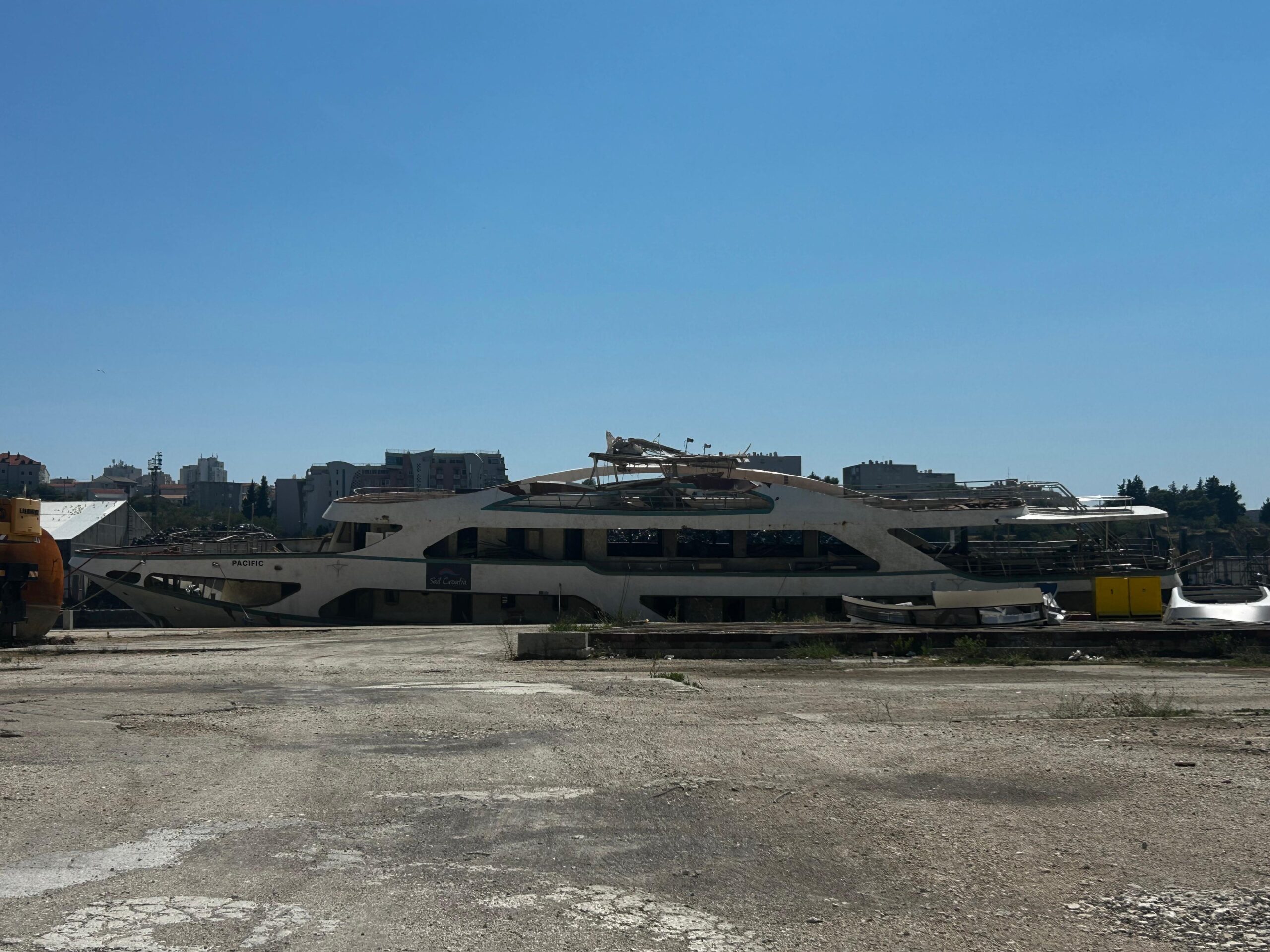
At the end of the navigation season, the passenger vessel Pacific was moored at her home berth in Krilo Jesenice, where she normally remains throughout the winter until the beginning of the next summer season. During this period, the crew does not stay on board, and the vessel’s owner, who is also the master, carries out regular visits to the vessel. The last visit took place on the day prior to the accident, when nothing unusual was observed. On 28 December at 05:30, the owner was informed that the vessel had sunk.
An inspection of the underwater part of the hull revealed a hole in the area of the central structural sewage holding tank, through which seawater had entered the tank. As a result of the increased weight due to flooding of the internal spaces, the vessel gradually sank and, during the night, came to rest on her side on the seabed at a depth of approximately 20 metres.
During the occurrence, minor damage was sustained by two vessels moored adjacent to the sunken vessel, and minor local pollution occurred, which was promptly contained and cleaned up.
The opening in the hull was temporarily sealed, after which the vessel was refloated. Upon completion of preparatory works, on 11 July 2025, the passenger vessel Pacific was towed to the port basin Vranjic – Solin.
The cause of the accident was corrosion of the bulkhead plating of the structural sewage holding tank, which also forms part of the vessel’s outer hull plating.
The following contributory factors were identified:
– Absence of inspection and monitoring of the internal condition of the structural sewage holding tank;
– Failure to implement measures to prevent progressive flooding of the hull through open ends of the sanitary piping system, as well as the lack of adequate equipment to implement such measures;
– Absence of continuous supervision of the vessel at the time of the accident.
The investigation highlights the need for more systematic supervision and maintenance of structural sewage holding tanks, particularly with regard to internal inspections, monitoring of anti-corrosion coatings, and thickness measurements of structural material, as well as the importance of coordinated measures to prevent progressive flooding and organised supervision of the vessel during the off-season period.
Based on the safety investigation conducted, and on the analysis, findings and conclusions set out in this report, the Air, Maritime and Railway Accident Investigation Agency issued three safety lessons and three safety recommendations.
Based on the safety investigation conducted, and on the analysis, findings and conclusions set out in this report, the Air, Maritime and Railway Accident Investigation Agency issued this safety lessons:
✓ AIN05-SL-10/2026
Prevention of Corrosion in Sewage Holding Tanks
Sewage holding tanks constitute a highly aggressive chemical and biological environment in which degradation of internal structural materials may occur. The decomposition of organic matter generates gases and compounds which, in the presence of moisture, form corrosive media on steel surfaces.
The risk is significantly increased where sewage is retained in the tank for extended periods, where ventilation is inadequate, and where tanks are not emptied, flushed and cleaned at regular intervals. The consequences may include wastage of material, cracking and leakage, and, in the case of structural tanks, potential compromise of hull integrity.
Regular and thorough inspections of the internal surfaces of sewage holding tanks should be carried out, including complete emptying, flushing and cleaning in accordance with the maintenance plan. Particular attention should be paid to structural steel tanks, where the condition of protective coatings should be maintained and any identified defects rectified in a timely manner.
The installation of non-structural holding tanks constructed from corrosion-resistant materials eliminates the risk of tank penetration and associated consequences. Where conventional designs with structural steel sewage tanks are in use, systematic monitoring, proper maintenance and early detection of corrosion are essential to prolong service life and prevent incidents onboard.
Recipients: This safety lesson is addressed to shipowners and operators, shipbuilders, maritime administrations, classification societies, and seafarers.
✓ AIN05-SL-11/2026
Prevention of Progressive Flooding through Watertight Bulkheads
Hull damage in way of a watertight bulkhead may result in flooding of a single compartment; however, the principal hazard arises when water spreads uncontrollably into adjacent spaces, leading to progressive flooding. Progressive flooding may occur through piping systems, drainage arrangements or other penetrations connecting watertight compartments, thereby defeating the primary function of the bulkheads and significantly compromising the vessel’s stability.
To prevent the spread of water following damage, all penetrations through watertight bulkheads should be fitted with effective means of closure, and drainage and sanitary piping systems should be designed and maintained so as not to create open paths between compartments. In the event of seawater ingress, the timely closure of such openings and the use of available sealing arrangements are essential to maintain buoyancy. Certain closing arrangements should also be fitted as a preventive measure, particularly during periods of reduced vessel operation.
Shipowners should ensure that damage control plans and manuals are complete, clearly presented and aligned with the vessel’s actual condition. The means provided for closing openings should be of an appropriate type and quantity, clearly marked, and readily accessible to the crew at all times.
It is equally important to conduct regular inspections, verify the integrity of installations passing through watertight bulkheads, and ensure that the crew are familiar with procedures to prevent progressive flooding. The timely implementation of these measures is critical to preserving vessel stability and preventing more severe consequences following damage.
Recipients: This safety lesson is addressed to shipowners and operators, shipbuilders, maritime administrations, classification societies, and seafarers.
✓ AIN05-SL-12/2026
Safety Measures of Vessels during Lay-Up Periods
A vessel that is not in commercial use during the winter period or outside the navigation season, and is without a permanent crew, remains exposed to risks such as seawater ingress, fire or technical failure. In such circumstances, the absence of oversight and timely response may lead to the development of hazardous situations that could otherwise be prevented or mitigated through appropriate organisation.
A vessel that is not in commercial use during the winter period or outside the navigation season, and is without a permanent crew, remains exposed to risks such as seawater ingress, fire or technical failure. In such circumstances, the absence of oversight and timely response may lead to the development of hazardous situations that could otherwise be prevented or mitigated through appropriate organisation.
Technical systems intended for early warning, such as high-level alarms or other safety devices, are only effective if supported by organised and continuous monitoring capable of responding to their activation. Without a continuous watch, designated personnel, or patrol arrangements, such systems cannot prevent the escalation of an incident.
Properly implemented lay-up procedures, combined with planned oversight and maintenance, are essential measures to preserve vessel safety during off-season periods and to prevent incidents and their associated consequences.
Recipients: This safety lesson is addressed to shipowners and operators whose vessels have seasonal lay-up periods, maritime administrations, and classification societies.
Safety recommendations are addressed to those best placed to implement them, with the aim of preventing future marine casualties and incidents and improving the safety of navigation. Safety recommendations do not determine responsibility or attribute blame for a casualty.
Based on the safety investigation conducted, and on the analysis, findings and conclusions set out in this report, the Air, Maritime and Railway Accident Investigation Agency issued this safety recommendations:
✓ AIN05-SR-7/2026
It is recommended that the Croatian Register of Shipping further specify, within the existing sections of its rules, including the associated tables and checklists, the requirements for internal inspections and thickness measurements of structural sewage holding tanks.
✓ AIN05-SR-8/2026
It is recommended that the Croatian Register of Shipping implement enhanced systematic monitoring of the condition of structural sewage holding tanks as critical structural elements on vessels of the same or similar design as the vessel Pacific.
✓ AIN05-SR-9/2026
It is recommended that company Javorak ensure that vessels temporarily withdrawn from service during the winter period are formally laid up in accordance with applicable requirements, supported by a lay-up plan. The plan should include a risk assessment, arrangements for continuous monitoring, safety measures, and procedures for emergency response.